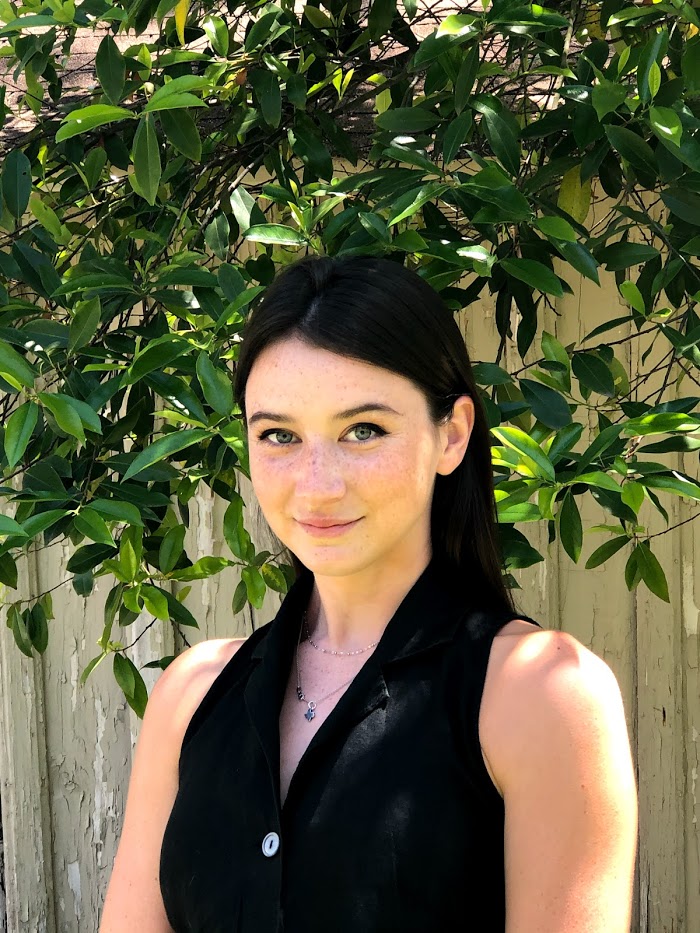
Emily Hardick
Historian
I am a historian of modern Africa and Europe. My research examines the transnational circulation and cultural politics of performing arts within colonial and authoritarian regimes. My dissertation and tentative book project, Choreographing (Im)mobility: Touring Performance and the Cultural Politics of Movement in the Congo, addresses these themes in the context of colonial and postcolonial Democratic Republic of the Congo, from the 1930s to the early 1990s. This project follows the international tours of Congolese performance troupes, their relationships to international arts organizations, and their role in the performance of colonial subjecthood and postcolonial national identity.
I come to this topic as a former dancer myself and from an interest in the contemporary phenomenon that many scholars have noted: African dancers—like many dancers from the Global South—have comparatively unique opportunities to travel internationally through the support of theatrical networks. Through my scholarship and teaching, I am interested in linking cultural performance to colonial legacies of extraction and questions of bodily freedom.
I am a Visiting Assistant Professor of African and Africana Studies at Haverford College for the 2026-2027 school year.
research
I have reccently published an article, “‘Our Explored Become Explorers’: Subversive Performance and Belgian Colonial Control in the Productions of Adolphe Kisimba (1958-9),” in The Journal of African History ; some of my other published writing can be found in Africa Today, African Studies Quarterly, and Origins: Current Events in Historical Perspective.
My book project, tentatively entitled Choreographing (Im)mobility examines the historical role of artistic practice in the shaping of contemporary African mobility, taking the colonial and postcolonial Congo as its case. African dancers, actors, and producers who lived in constrained political environments—be they colonial or postcolonial states—have leveraged the popularity of their onstage movements to travel widely, evading, engaging, and negotiating the state in the process How then, this project asks, do performers use bodily and artistic practices to create the conditions for their own freedom, be it imagined or realized? I examine this phenomenon beginning in the Belgian Congo in the 1930s, when Belgian colonial administrators sponsored international tours of purportedly traditional Congolese music and dance for eager European audiences. Congolese performers instrumentalized these audiences’ perceptions of Africans’ “innate” bodily expression—and the micro-level mobility this stereotype implied—to navigate the bureaucratic restrictions that governed African international mobility and fashion large-scale geographic mobility across the colonial world. As the first history of Congolese performance that spans both colonial and postcolonial eras, (1930-1981), Choreographing (Im)mobility reveals how Congolese performers’ choreographic practice became a negotiation of empire, decolonization, and Mobutu Sese Seko’s dictatorship. By exploring where these on- and offstage movements enabled—or failed to enable—new forms of freedom, the project offers a new cultural history of the relationship between performance, the pursuit of travel, and the global regimes that shape African mobility today.
This project has been supported Fulbright Belgium, the Belgian American Educational Foundation, the Foreign Language and Area Studies Program, and the OSU Mershon Center for International Security Studies, among others.
Teaching
I have taught, lectured for, and assisted with a wide array of courses in African, world, and European history. Broadly, my pedagogy is method-driven, using diverse sources to emphasize history as a process of knowledge production. As an instructor at OSU, I have taught HIST 2302: History of Modern Africa, 1800-1960s and HIST 2650: The World since 1914.
Public Scholarship/humanities
Since 2022, I have worked as part of TRACER, an artistic research collective organized with Sarah Van Lamsweerde, Anne Wetsi Mpoma, Emmanuelle Nsunda, Nizar Saleh, Esther Mugambi, Raoul Carrer.
Tracer investigated these possibility of “restaging” archival fragments and ephemera of a Belgo-Congolese colonial performance central to my dissertation/book project, Changwe Yetu (“our festivity,” 1956-8). Using historical methods and experiments in conservation, this group is invested in reworking immaterial practices from the colonial past in the pursuit of new, fairer Global North-South relationships. Tracer has shown pieces at Enough Room for Space Independent Art Initiative (Brussels, 2022), Wetsi Art Gallery (Brussels, 2023), Kunsthalle Mainz (Mainz, Germany, as part of “Unextractable: Sammy Baloji Invites,” 2024), and Atelier Picha (Lubumbashi, DRC, as part of the Lubumbashi Biennale, 2025), and is supported by the Flemish Government Arts Decree. Information on first residencies here and 2023 feature in Bruzz Magazine here.